Showing posts with label Culture. Show all posts

Saturday, January 15, 2011

No Regrets

Chez Louisette

I'm not a big fan of cultural stereotypes. It seems to me that I know plenty of sophisticated Americans, punctual Mexicans, sloppy Germans, and at least one or two people of Irish decent who don't drink. But at the same time, I can't help but make very simple observations about groups of people as I travel. Two weeks in Paris convinced me that the French like nothing better than to wallow in their French-ness. They revel in it in a thousand different ways. Across the Rhine in Germany, that's not the case. To the extent that one can indulge in cultural stereotypes at all, it's good to keep in mind that these things are in constant flux. But I remember attending several parties in Germany during the year 2001-02, and before we had passed the 9:30 mark, someone would always say with predictable regularity,  "I don't think of myself as a German, I'm really more of a citizen of Europe." I might have responded, "Yeah, but the rest of Europe sees you as a Kraut", but I was far to tactful.

Whatever the Germans might be thinking about their own cultural allegiance, the French have no such reservations. And spending time in the company of a big group of people who are enjoying being themselves is really a lot of fun. I had the opportunity to do just that, a week ago today, when I attended what was billed as the "largest fleamarket in the world!" just north of Paris: Le Marche Aux Puces De Clignancourt. It was really big, but unfortunately, also very cold. My fingers grew numb pawing through bins of wonderful French junk and winding down narrow aisles and alleyways filled with antique glass, china, furniture, 78 rpm recordings, chapeaux, books... After a long morning, I was glad to find a restaurant (Chez Louisette) in a cul de sac across from a curio booth selling Zippo lighters. But it turned out to be more than a meal. It was a mind-blowing experience and lesson in the art of being French.

We entered to a din that almost drowned out an older woman with jet black hair who stood less than six inches to my right, channeling Edith Piaf at the top of her considerable lungs. There wasn't an open seat in the joint, but a group right in front of us got up and offered us their seats. We maneuvered ourselves into position at a four or five meter-long table, jammed with people. Waitresses squeezed by with platters of food that had an obviously strong Alsatian influence. One wore a whistle around her neck which she used to get the attention of any diner who had the temerity to relax and ease their chair back a few centimeters into the narrow pathways between tables.

The woman singing was Manuela, a local legend. But she was followed by other singers who did mostly French favorites with lots of sing-along parts. While performing, each singer was unavoidably jostled by patrons and servers alike as they tried to move through the mass, but none of them seemed fazed in the least by the distraction. After each chanteuse completed her set, she worked the room with a basket for tips. Manuela was particularly effective, encouraging patrons to dig a little deeper, in a goodhearted but strangely firm manner. We stayed for at least four sets and these gals pretty much cleaned us out.


None of the photos that I took come anywhere near close to capturing the energy and intensity of Chez Louisette, but a quick scan of the blogishpere gave me my choice of videos on YouTube. I'll include a couple here, but I think it's a place you really have to visit to understand. I've been in a number of similar situations in Germany over the years, but the German cultural soundtrack isn't songs from the war years; it's mostly stuff like Bad Moon Rising or songs by the Eagles. You might hear a Deutschrock hit from the Wirtschaftwunder years that would trigger the kind of enthusiasm in a Köln Kneipe that I witnessed at Chez Loiusette, but can I imagine a roomful of middle class Germans enjoying an afternoon of Sauerbraten and a rousing chorus of Lili Marlene? Ich don't think so.


_________________________________________________
___________


Sunday, May 30, 2010

Satellite

There are lots of Americans on the streets of the Ruhrgebiet right now. Maybe it's the effect of the Kulturhauptstadt celebration going on this year, or it could have some other cause I'm not aware of, but they're impossible to miss in a crowd. There's something about the American accent that gives the voice a sharper edge. It cuts through a background pattern of other voices that blend easily with one another. And then there's the content. Americans prefer one phrase that I hear often when walking in a crowd and it's instantly recognizable:

"And I'm like..."

I never get to find out what they're like, because the conclusion to the phrase is optical, not aural. Presumably at the proper moment, the speaker makes a face of some kind to demonstrate just exactly what they are like. In a crowd of moving people, it's usually not possible to identify the speaker and satisfy my curiosity. I move through the crowd, knowing that I'm surrounded by people who are like something, but never knowing exactly what. It's just a little frustrating.

With Europeans speaking English this is never a problem. Since it's not their mother tongue, they haven't yet mastered the skills of discourse with a severely limited vocabulary. Where Americans can carry on a conversation for several minutes, cleverly limiting themselves to only a handful of words, Europeans are forced to fall back on a wide vocabulary. It was nowhere so clearly evident as in the Euro Vision Song Competition I watched last night on TV, televised from Oslo, a city where the citizenry is notorious for having to depend on a knowledge of grammar and vocabulary as a kind of coping skill in English.

I don't think the average American is aware of Euro Vision, but in Europe it's a monster event. What intrigued me about last night's performance was primarily the role that language played, and in particular, the English language. In the early years of the competition, it was understood that each country would perform in their own national language. Later, strict rules insured compliance. But in 1973, the rule was relaxed and that was the year ABBA won with Waterloo. The floodgates were officially opened on English and everyone got on board.

In last night's performance, well more than half of the singers performed in English and it clearly demonstrated a curious fact: English speaking countries are no longer leading the way when it comes to grammar and pronunciation development. These aspects of language are always in flux, and previously they shifted according to trends within the regions where English was spoken as a primary language. I believe now, foreign speakers are influencing English more than we are.

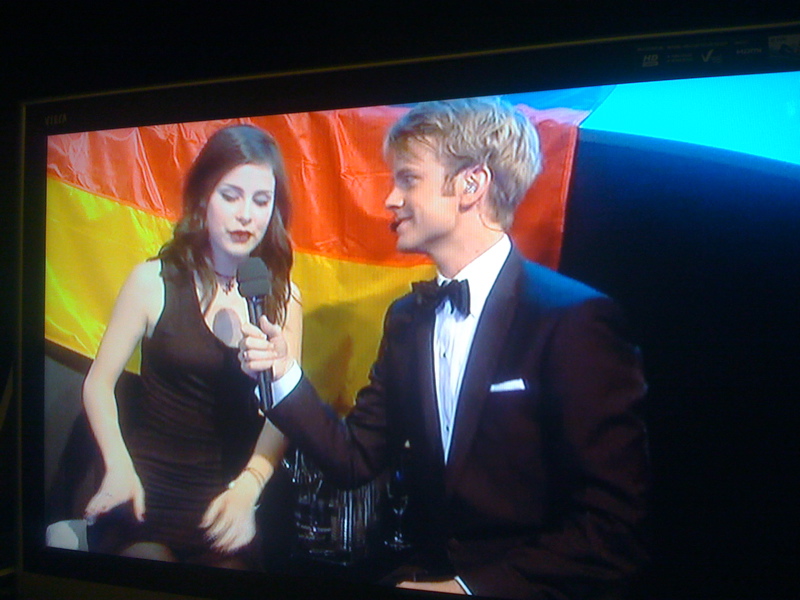
The German entry to this year's competition, Satellite, sung by the 18 year old sensation from Hannover, Lena, is a good example of this trend. Lena speaks beautiful English, (hampered as she is by a too large vocabulary and a lot of useless knowledge of grammar) but her pronunciation is naturally not that of a native speaker. When she sings, she subtly shifts the stress in certain words, or alters the glottal stop in others, creating a pattern that's a little tricky for me to understand. But the fact is, it sounds great. The words are slurred and inflected in a way that comes across as innovative and really appealing. Satellite is a little too "Pop" oriented for my tastes, but no one could deny that it's catchy. Plus, Lena's somewhat spastic stage presence was a welcome relief from the schmaltzy, over produced performances of some other contestants. (Yes, I'm thinking about Russia here.) It was a fact recognized by the voting public: Lena won in a landslide.


Lena interviewed after her win by Norwegian media cyborg, Erik Solbakken.

As the voting was announced last night from the capitals of Europe, I believe I'm correct in saying that the only country that did not give its results in English, was, predictably, France. Which puts the French in the odd position of having about as much influence over the shaping of spoken English as we have in America. Like the French, we Americans speak as little English as possible. We like to stick with one verb tense, (when was the last time you heard someone say "And I have been like...." or "I would have been like...?" ) a handful of simple words and many of us have abandoned adjectives and verbs almost entirely. Meanwhile, our language sails on without us, growing all the while. I can imagine a time when many of us won't be able to understand spoken English at all. And how does the average American feel about that? They're like... "Whatever?"

Their apathy is probably attributable to a blind faith in the power of the American Pop Cultural Juggernaut. It seems to roll over everything in its path and always triumphs in the end. It probably will in the case of spoken English too, in spite of my concerns. It certainly didn't escape my notice that in this competition, which is closed to non-Europeans, it was an American, Julie Frost, who co-wrote the winning song with the Dane, John Gordon. I admire the French for their courage, but I hope they're buying shares in Disney. Enjoy the video.


Tuesday, April 13, 2010

Erstes Futter

Although there is currently an open slot for a saint named Christopher, (see post, Hang on, Saint Christopher) I don't anticipate being elevated to the Canon when I die. I simply have too many faults. But although I recognize my own imperfect existence, I have a generally positive self image. I'm more or less pleased to be me and think most of the time, I'm a pretty good guy. So it comes as a shock when I'm accused of wanton cruelty or blatantly immoral behavior.


As it turns out, my actions have come under attack most aggressively at this time of year, in April, the cruelest month, when lilacs are bred out of the dead land and it's time to prune the willows. When I was a kid, cutting pussy willows was a time-honored tradition. I remember encountering pussy willow catkins even before I entered kindergarten and thinking that they must indeed have been a kind of transspecies creature, formed by crossing kitties with what we always called a "pricker bush" in my neighborhood. It struck me as a fine idea. When I was a little older, I encountered pussy willows in the classroom too and I retain fond memories of these delightful harbingers of spring.

Here in the US, I have a willow growing in my backyard and can cut pussy willows with abandon. Not a spring goes by when I don't cut a few of the earliest shoots to put in a vase in the dining room. But during the years I've spent in Germany, finding a pussy willow wasn't always easy. Sure, there's plenty of rural territory in Germany, but I've always been stuck in the city and avoided taking cuttings from my neighbors, most of whom, I in any case didn't know. You can imagine my pleasure then, when on my most recent stay in Germany, I found a willow growing along a public path. It was a former railroad cut, not maintained as a park, and I reasoned that no one would object if I cut a few shoots to bring home. We wanted to decorate the apartment festively for a party on the weekend.

I was in high spirits until our first guests arrived. It seems that in Germany, children aren't taught to see catkins as the first symbol of spring, but rather as the "first food for the bees." With those pussy willow shoots on my table, all anyone could think of were the the poor starving bees, lying cold and hungry among the crocus in some lonely German pasture. Conversation was difficult and got harder as each of us imagined we could hear the plaintive buzzing of a dying hive, the victim of my thoughtlessness. I didn't like this image of myself as bee-killer, so when the guests went home, I researched this cultural attitude toward the pussy willow thoroughly. It turns out, bees do depend to some extent on willows in the early spring. And this "first food for the bees" thing does run pretty deep in the German psyche. Again and again I uncovered evidence on-line of indignant German speakers, reacting to crimes against the bees. I made a decision to be more sensitive to cultural values and lay off the pussy willows while in Germany.


Willows in America don't respect this new attitude on my part though. They grow like Topsy and this spring the cute little pussy willow I planted behind my house was getting up around five meters high. I hope no one in Germany finds out, but this weekend, I cut it off at the ground and the bees be damned. New shoots will come up and I intend to maintain it as a bush from here on in. Maybe I'll put out a saucer of sugar water for the bees, but come on: rural Utah is lousy with willows. Surely the bees can find some other sucker to provide their first food. And when he dies, I'll nominate him for canonization myself.